

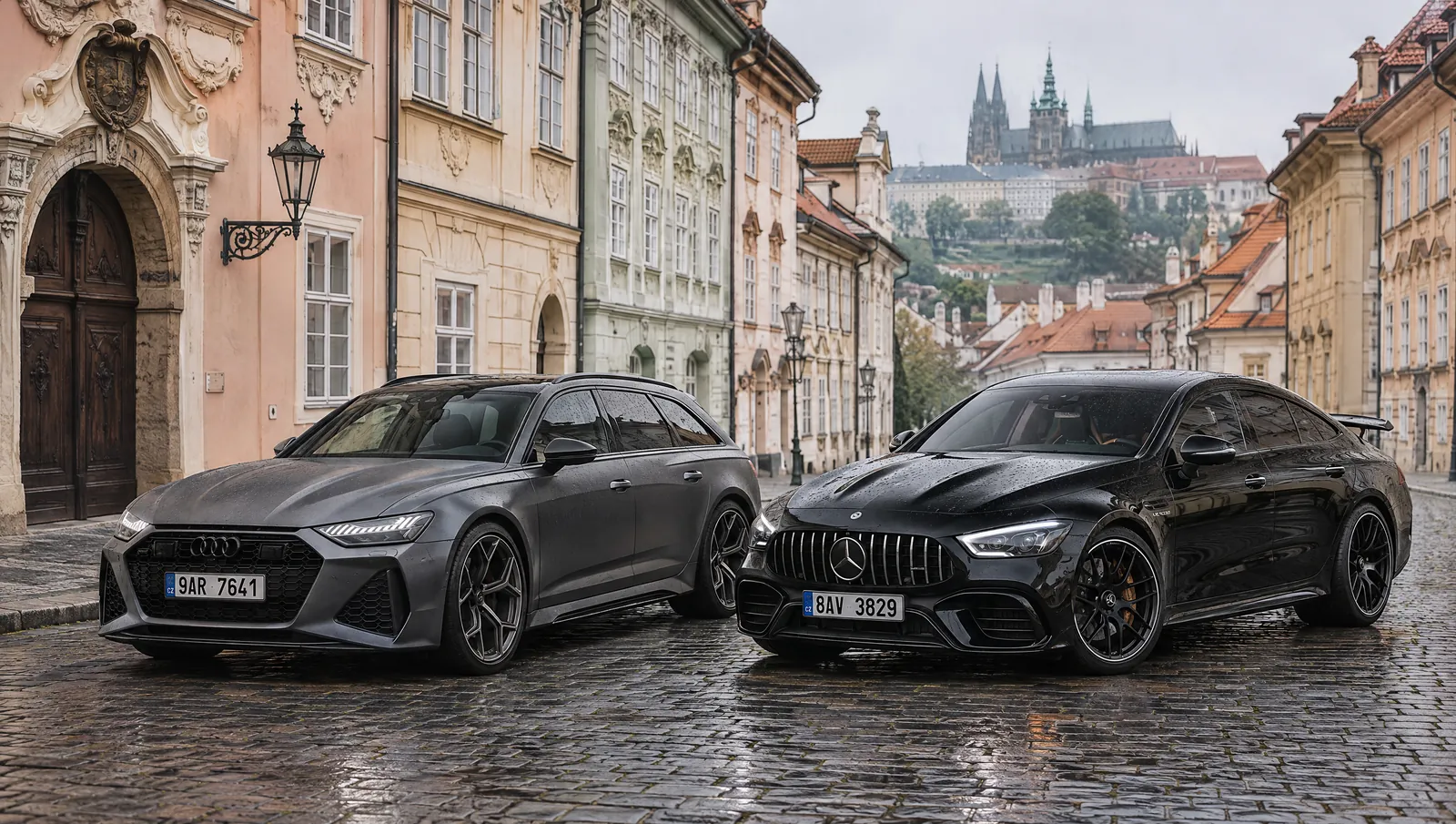

Audi RS6 and Mercedes-AMG GT 63 S belong to the same odd category of cars that, by common sense, shouldn’t really exist. Both are family vehicles for four or five people, both sprint to 100 km/h faster than plenty of purebred sports coupés, and both pack more than 600 horsepower through all four wheels. On paper they look alike, 630 horsepower for the RS6 against 639 for the GT 63 S, both just over three seconds to 100 km/h. How they got to those numbers, and how they behave once you’re actually driving, is where the real difference starts.
Two philosophies, one foundation
Both cars run on a twin-turbo 4.0 litre V8, a different branch of the same basic bi-turbo V8 concept that has spread across both manufacturers’ lineups in recent years. AMG engines are still hand assembled in Affalterbach, one technician per engine, with a plaque on the intake bearing that person’s signature. Audi’s RS lineage, meanwhile, traces back to 1980 and the legendary Quattro rally car, the machine that first proved all-wheel drive could be an advantage on tarmac, not just a trick for snow.
From that shared starting point, the two cars head in opposite directions. The RS6 stays an estate because Audi’s philosophy is that power should be hidden, not put on display. The GT 63 S does the opposite, making drama the whole point, its four-door body with a low roof and long hood visibly borrows its face from the two-door AMG GT sports car it shares a family resemblance with.
RS6 Avant: a car that doesn’t need a second car
The RS6 is an estate, and that’s its main weapon, not a compromise. The boot swallows bikes, skis, or a furniture run just as well as an ordinary family wagon, the rear seats fit taller adults comfortably, and the higher roofline and bigger windows give far better visibility than any low sports body can manage. At the same time it carries an engine that launches it to 100 km/h faster than plenty of cars that style themselves as pure sports machines.
That combination makes the RS6 a car you don’t have to pick based on the occasion. It works just as well on a highway run to the Alps with luggage for the whole family as it does on a regular commute, and nobody around you would guess the driver has nearly seven hundred horsepower underfoot until the throttle goes down. That ability to blend in, then overtake everyone in an instant, is exactly why the RS6 has become one of the most popular cars in fleets across Europe.
GT 63 S: a car that refuses to blend in
The GT 63 S takes the opposite path entirely. Its low nose, long hood, and tight coupé silhouette, despite having four doors, make it something you spot from far away and hear even sooner. The switchable exhaust system goes from a quiet crawl through town to a fully open mode that’s an experience on its own under a bridge or through a tunnel. Inside, two large displays stretch across the dashboard and the sport seats sit noticeably lower and tighter than in the RS6, matching the car’s dramatic character.
That drama comes at the cost of a smaller boot and worse rear visibility, a trade every low-roofed, small-rear-window car makes. The GT 63 S doesn’t pretend to be practical, because nobody buying one expects it to be. Its job is to be the centre of attention in a restaurant parking lot, at a photoshoot, or on an evening drive through town, where what matters most is how the car looks and sounds.
All-wheel drive, done differently
The difference between the two cars is just as clear behind the wheel, and it mostly comes down to how each handles all-wheel drive. Audi’s quattro system in the RS6 splits power between the axles through a mechanical differential and stays permanently balanced, so the car feels stable and predictable in every situation, in the rain, on an uneven road, or driving fast. Mercedes’ 4MATIC+ in the GT 63 S can instead shift most of the power to the rear wheels in certain modes, and in its sportiest setting can decouple the front axle entirely, letting the car behave almost like a pure rear-wheel-drive machine. That makes it livelier and more playful through corners, but also more demanding on the driver if you want to use that side of it properly.
In everyday terms, this means the RS6 forgives mistakes and never feels nervous, while the GT 63 S rewards precise work on the wheel and throttle with a correspondingly bigger dose of fun.
What to actually weigh when choosing between cars like these
Choosing between two cars this powerful shouldn’t come down to the spec sheet alone. A few questions matter more:
How many people and how much luggage are travelling, and how long is the drive. An estate with a big boot and a higher seating position stays comfortable over long highway or mountain stretches, while a low sports coupé tires out your back and eyes sooner, especially on rough pavement.
Whether you want to stay inconspicuous or be seen and heard. Some cars are built to blend in and surprise you at the next traffic light, others are built so that everyone around notices immediately.
What weather and road surface you’re expecting. Both cars have all-wheel drive, but only one of them is tuned to feel just as sure-footed in the rain as in the dry. If you’re planning mountain driving in autumn or winter, lean toward the car with the more balanced, less sport-biased drivetrain.
How much experience you actually have with high-powered cars. A car that can decouple its front axle and behave like a rear-wheel-drive machine is enormous fun in the hands of an experienced driver, and genuinely risky in the hands of someone who has never driven anything this powerful before.
Where cars like this come alive
Both types of car come alive on roads that are anything but flat and empty. Alpine passes, the Grossglockner or the Stelvio among the most popular, are a favourite among owners of cars like these across Europe, putting real strain on the chassis and brakes while rewarding the climb with views worth the drive on their own. Closer to home, roads through Šumava or the Krkonoše mountains offer a similar mix, long straights alternating with technical corners, and traffic that’s usually far lighter than on the main routes.
When planning a longer trip, it’s worth remembering that engines like these drink noticeably more fuel under hard driving than an ordinary car, so it pays to map out more fuel stops than you’d expect, especially in the less populated mountain stretches. And if more than one person is driving, it’s worth reading through the rental’s insurance terms before anyone signs, so everyone agrees on what counts as normal wear and what counts as damage.
Which one to choose
If you want one car for everything, for the highway, for a family trip, and for the days you just want to feel the power, without giving up practicality to get it, take the RS6. If what you’re really after is the experience, how the car looks and sounds, and you can live with a smaller boot and sitting closer to the ground, the GT 63 S is the clear pick. Both represent their brands at the peak of what they can do, they just aim in completely different directions.